Ellen Peirson Wins 2026 Wheelwright Prize

Harvard University Graduate School of Design (GSD) is pleased to name Ellen Peirson the winner of the 2026 Wheelwright Prize. The $100,000 prize supports investigative approaches to contemporary architecture, with an emphasis on globally minded research.
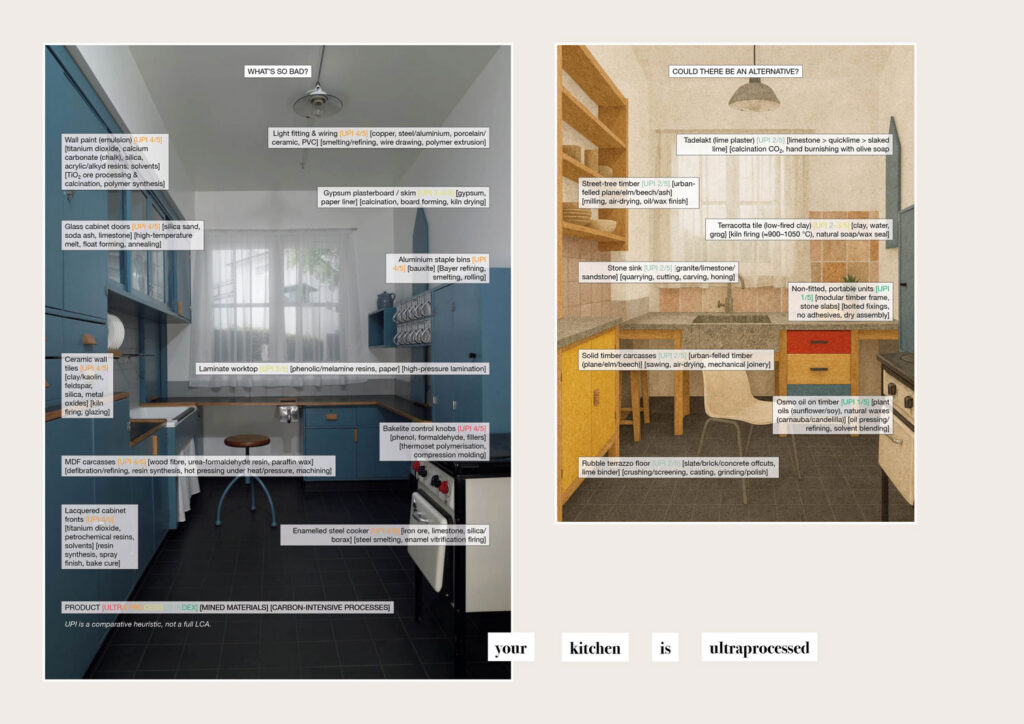
Peirson’s project, “Ultra-Processed Kitchens: Infrastructures of Extraction in the Home,” advances from the premise that the built form of the private home is a matter of public concern. By analyzing kitchens as “mineral landscapes” comprising materials such as clay, gypsum, and silica, Pierson examines how these sites of domesticity are entangled with extraction, petrochemical dependence, and waste. Her project dissects a typical kitchen’s materials, supply chains, aspirations, and tastes, and proposes an alternative: kitchens that can support well-being and sustain ecological limits through an aesthetic of reuse and care.
“The construction industry, at its worst, is toxic to land and people,” says Peirson. “Yet to make a home, whether through walls, objects, people or ideas, is one of the most human things we can do. The kitchen concentrates that tension: a place of ritual and sustenance, assembled from materials whose extraction and manufacture can cause harm far beyond the home.”
The Wheelwright Prize supports innovative design research, crossing both cultural and architectural boundaries. Winning research proposal topics in recent years have included the architecture of Alpine communities; social and spatial relations in contemporary Africa; and the environmental impacts of sand mining.
The Wheelwright Prize will fund two years of Peirson’s research. “We urgently need to rethink how and with what we build, but we must do so in a way that both prioritizes care and makes space for delight, in search for a domestic architecture that is responsible and beautiful,” says Peirson. “Rethinking takes patience, and change needs time to take hold. This prize will give me the time to pursue these questions beyond practice and carry that thinking back into my work. I am grateful to Harvard GSD and the Wheelwright jury for recognizing a project that confronts difficult realities woven into how we make home. We need a reckoning with the way things have always been done, and with the possibility that our homes may be doing us real harm. I am really excited for the work ahead.”
“Ellen asks us to see the kitchen not as a domestic backdrop but as a capillary of global infrastructure, a highly personal space where mined gypsum, quarried silica, and petrochemical laminates and resins come into contact with our most intimate aspirations,” says Sarah M. Whiting, Dean and Josep Lluís Sert Professor of Architecture at the GSD. “Her project connects the scale of kitchen cabinet design to the planetary scale of commercial manufacturing, and insists that our choice of building materials—and especially the toxicity they bring into our everyday lives—is a question of both public health and land stewardship. Along with the rest of the jury, I could not be more thrilled that she is this year’s winner.”
In addition to Whiting, jurors for the 2026 Wheelwright Prize include: Mariana Ibañez, associate professor and chair of UCLA Architecture and Urban Design, and co-founder of Ibañez Kim; Marina Otero Verzier, lecturer in architecture at Harvard GSD and 2022 Wheelwright Prize Winner; Jennifer Newsom, co-founder of Dream the Combine and assistant professor at Cornell University’s College of Architecture, Art, and Planning; Charles Waldheim, John E. Irving Professor of Landscape Architecture, director of the Office for Urbanization, and co-director of the Master in Design Studies program at Harvard GSD; and Oliver Wainwright, architecture and design critic of The Guardian and 2026 Loeb Fellow.
“Ellen’s project demonstrates that meaningful change can emerge from intervening in the most seemingly ordinary aspects of design,” says Otero Verzier. “She proposes to study the homogenization of kitchen design over recent decades driven by very specialized products and increasingly narrow supply chains. The kitchen, in this context, becomes a highly processed architecture passed off as a domestic backdrop, and a space of social aspiration. Yet, we often take for granted the high environmental and health costs of these kitchen designs, which rely on highly polluting, non-renewable materials. Because these kitchens are produced on such a vast scale, even small shifts in their design can have far-reaching consequences. The jury is convinced that Ellen’s project has the potential to catalyze precisely this kind of systemic change.”
Peirson was among five distinguished finalists selected from a highly competitive and international pool of applicants. The 2026 Wheelwright Prize jury commends finalists Olga Cobușcean, Junho “Sohun” Kang, Mohamad Nahleh, and Brittany Uttingfor their promising research proposals and presentations.
About Ellen Peirson
A London-based architect and writer, Peirson works at the intersection of material ecologies, domestic life, and policy. She examines how architecture can tell stories about who we are and the world in which we live. In her role at Mike Tuck Studio, she led Don’t Throw Your House Away, a RIBA-funded study on embodied carbon in everyday home renovations. She puts this into practice through her work on low-toxicity, breathable retrofits in London. She also regularly writes on architecture, reuse, and housing justice for publications including The Architects’ Journal and The Architect’s Newspaper. Peirson’s current practice-based research follows how mineral supply chains pass through the home, maintenance and repair become cultural acts, and renters experience these systems.